Long Exposure
To produce his debut book, MAPALAKATA, photographer Robin Bernstein travelled across continents to the Mpumalanga escarpment, then almost 50 000 years back in time.
ART / 05.06.26
Read time / 10 mins
Mikael wears his take on an office t-shirt in a formal mid-weight cotton pique. On the blind behind him is the FIELDS brand totem, designed by Daniel Ting Chong.

01
[01] “It was pretty tricky to get up close to the horses,” notes Robin on one of the first images he photographed for his debut photo book. “But with some persistence and horse whispering, I managed to get a few usable frames.” Wild Horse, 2019.
In the entrance hall, natural light refracts off the citrusy-orange front door, generating a welcoming glow.
“It was pretty tricky to get up close to the horses,” notes Robin on one of the first images he photographed for his debut photo book. “But with some persistence and horse whispering, I managed to get a few usable frames.” Wild Horse, 2019.
“Ah, what a question,” Robin Bernstein writes via email from his apartment in London. The South African photographer has had a productive six years since leaving Cape Town for the UK, culminating with the publication of his debut photography book, MAPALAKATA. A socio-spatial portrait of the Mpumalanga escarpment area, equal parts majestic and mysterious, the book is the result of six dedicated trips, each ranging between two weeks and a month, and most of them since his move to the UK.
And so the question, one HOMEY loves to ask, is about those journeys, both conceptually and logistically. For this feature, Robin chose to be interviewed in writing. His responses, succinct yet descriptive with the rhythmic ease of a seasoned novelist, echo the nature of the imagery he constructs. “I would like my photographs to be more akin to scenes from a novel than a historical document,” he writes. While MAPALAKATA’s mix of confronting portraiture and striking landscapes certainly achieves this vision, the presence of a foundational historical component gives the work a relevant gravitas.

02
“The Ngwenya iron ore mine in Eswatini, just across the border, has undergone numerous iterations of extractive processes over the last 43,000 years,” writes Robin. These histories “point to the cyclical nature of people's engagement with land in this place, which, in turn, points to the broader themes I aim to unpack through this body of work.” View from The Lion Cavern, the oldest site known to have been mined by humans. Ngwenya Mine, 2025.
Robin’s journey starts through time before space. He first visited the Mpumalanga escarpment on a road trip in 2018. The jagged mountains separating the Highveld plateau from the Lowveld, part of the Drakensberg range, are home to wild horses descended from a failed gold rush shortly before the discovery of gold in the Witwatersrand. MAPALAKATA includes photographs of The Lion Cavern at Ngwenya Mine, the oldest site known to be mined by humans, sprawling alien timber plantations, and an eccentric cast of personalities who live and work there today. But it was the horses that first captivated Robin’s imagination, compelling him to circle back and photograph them: “A pretty difficult task with a Mamiya RZ [camera] and the very limited film I could afford back in those days.”
“I would like my photographs to be more akin to scenes from a novel than a historical document,” writes Robin.
Months before leaving his apartment to catch the London Underground, Robin begins his pre-production process with thorough research. The Mpumalanga escarpment’s history is as layered and jagged as its terrain. The record goes all the way back to prehistoric rock art and Iron Age farming communities around 500–1500 CE. Robin read Indaba My Children and Zulu Shaman by Vusamazulu Credo Mutwa, on pre-colonial gold mining in the region, intertwining traditional Zulu folklore with narratives about extra-terrestrial beings.
03
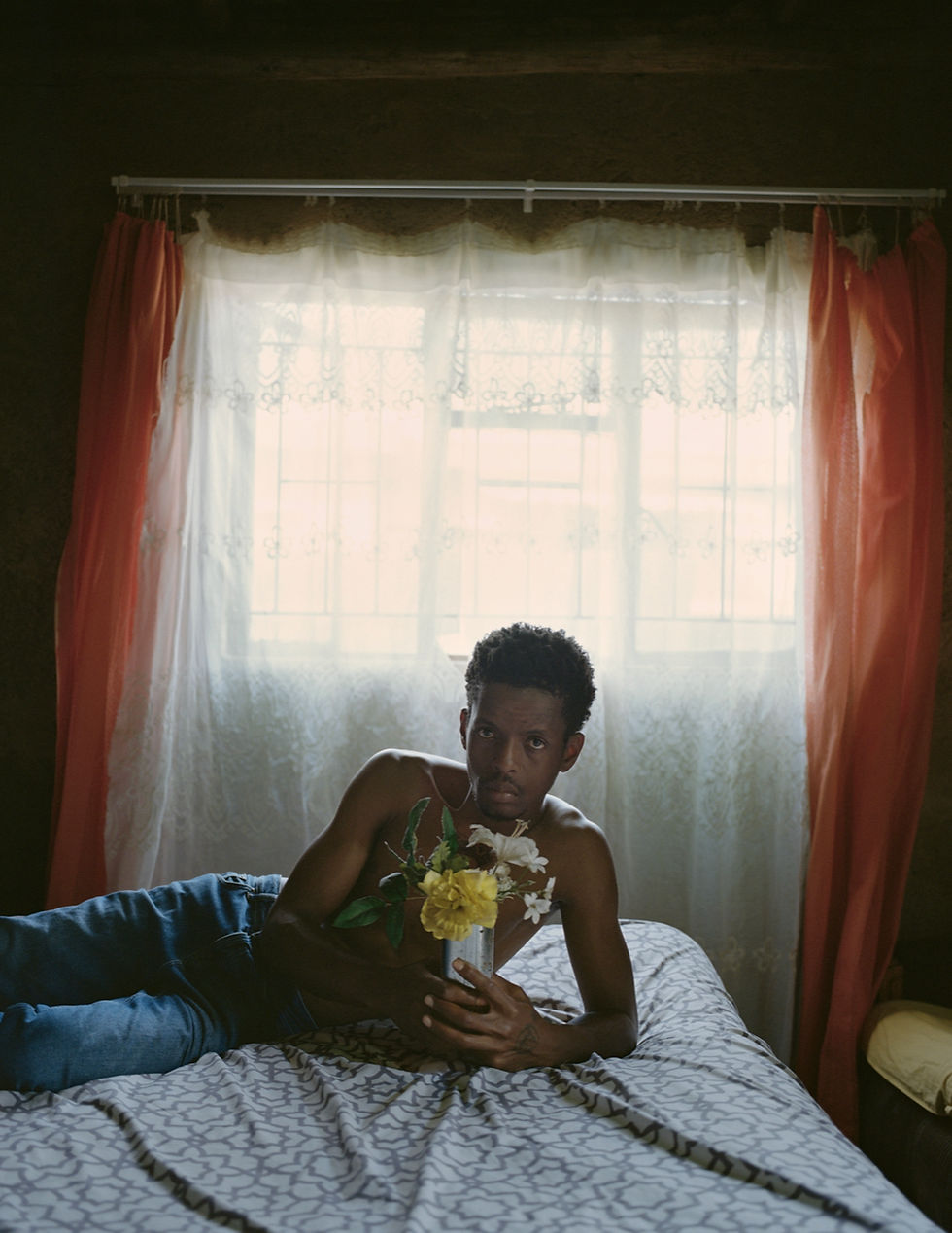
MAPALAKATA travels through time, juxtaposing images of ancient sites with a cast of characters living and working there today. Tony, 2025.

04
A lack of investment and infrastructure means multiple gold mines in the area are operating in a recessive capacity. “They are closing down tunnels faster than they are opening them,” Robin reports. “When tunnels close, they are left abandoned and often become repurposed by illegal miners (’Zama Zamas’).” Dormant Sheba Adit, 2020.
“I also read controversial New Age figure Michael Tellinger, whose Temple of the African Gods espouses the view that the region’s stone ruins were built by ancient deities to magnetically charge their spaceships while they harvested gold.” Part of the allure of the escarpment, as articulated in A Boy Who Is Made Of Stone, a short story by Lidudumalingani to accompany the images in MAPALAKATA, is the folklore that wafts through its stratified historical record. “I was interested in how these narratives attempted to negate the accepted archaeological knowledge that the stone ruins were actually built by the Koni people — a precolonial farming society who, in turn, had their history suppressed by the apartheid government.”

05
FIELDS sweaters are knitted from Responsible Wool Standard-certified fibres, meaning the sheep are ethically raised on farms that protect soil health and biodiversity.
[01] Mikael wears his take on an office t-shirt in a formal mid-weight cotton piqué. On the blind behind him is the FIELDS brand mark, a totem designed by Daniel Ting Chong.
In the eight years Robin has dedicated to producing his book, he’s become “less rigid with the camera — looser,” taking time to immerse himself in the world he’s photographing without the pressure of a fixed shoot schedule. Mbombela, 2022.
“I’ve come to realise that foundational ideas come from engaging with space in a normal way, like going for a run or hanging out with friends.”
FIELDS sweaters are knitted from Responsible Wool Standard-certified fibres, meaning the sheep are ethically raised on farms that protect soil health and biodiversity.
[01] Mikael wears his take on an office t-shirt in a formal mid-weight cotton piqué. On the blind behind him is the FIELDS brand mark, a totem designed by Daniel Ting Chong.
The overnight London–Cape Town flight “feels cathartic,” writes Robin. “I try to get to sleep early and wake up over the deserts of Angola or Northern Namibia at first light. Glancing out the window, I always feel the same combination of relief and excitement at seeing such open, empty and expansive land. I spend these last few hours of the flight watching the beiges, reds, browns and greys of the desert and semi-desert below me, and I think about the transience of people through these areas over the course of history.”
Part of the allure of the Mpumalanga escarpment is the folklore that wafts through its stratified historical record.
Robin’s move to the UK was fuelled by connections he made in Cape Town’s commercial photography world as a highly sought-after lighting technician. “I definitely exhibit a certain level of particularity when it comes to packing and equipment management,” he writes. That disposition is key to his success as a photo assistant, lighting director and gaffer in London — and of course to creative projects like publishing a photo book. “Both silos of my professional focus, while inherently different, supplement one another in a symbiotic manner. I can self-fund my creative work with income from technical commercial work, which in turn is enabled by my knowledge and experience in the creative field.”

06
Edwin Bray's Golden Quarry at the Sheba mine "was named both for its abundance of gold and for the golden quality of the light that filters in through openings at the top, causing all the rock faces to appear gold," writes Robin. Once one of the world's richest gold deposits, it is closed today. Sheba Mine, 2025.

07
“I met Johan during my first visit to the area,” Robin remembers. “He had a metal detector and told me he knew of some spots where illegally mined gold and lost treasure are rumoured to have been buried. We went on a hike to see a spot he was keen to search.” Johan, 2019.
The 20-hour drive from Cape Town to Barberton feels less daunting spread over three days. On most trips, Robin’s base camp was a disused bowls club at the top of the New Consort Gold Mine, which has been active for around 100 years. Producing this body of work, “I think I’ve learned to become less rigid with the camera — looser,” he writes. “I’ve also learned that there is a lot of benefit in not shooting all the time. On early trips, I was up every morning before sunrise, pushing myself to make pictures. On later trips, I’ve learned to break that up and give time to rest as well as shoot. I’ve come to realise that foundational ideas come from engaging with space in a normal way, like going for a run or hanging out with friends. This also means staying for a longer period of time, to have that space to just be with a place and with people.”
Robin’s base camp was a disused bowls club at the top of the New Consort Gold Mine, which has been active for around 100 years.
Robin encountered the term “MAPALAKATA” in historian Cyril Hromnik’s “somewhat controversial” writings, as a descriptor of Indian Ocean traders who frequented the Mpumalanga region and contributed mythical narratives to the landscape. “I felt this was an appropriate representation of how we are all only visitors for a time — here for a short while and then gone.” There’s a chance that this extinct term might never really have existed in the first place, and that’s the point. “It’s this sense of transience that drew me to choose it for the work's title.”

08
The term MAPALAKATA, now extinct, may never have existed at all. Robin encountered it in historian Cyril Hromnik's "somewhat controversial" writings, as a descriptor of Indian Ocean traders who frequented the Mpumalanga region. "It's this sense of transience that drew me to choose it for the work's title.” Judith, Simon, Solomon, Millicent & Unknown, 2022.
The idea of relocation echoes through Robin’s personal life — he and his wife plan to move back to their home country eventually. His great grandparents fled Eastern Europe at the turn of the 20th century to settle in Zimbabwe. Young Robin would visit his grandparents in Harare, spending hours poring over photographs and historical paintings in their library. “I used to draw a lot of things inspired by the images in those books, an activity that occupied much of my time in primary school classrooms, where I was often reprimanded. Looking back, I consider this the foundation for my interest in photography.”
Now that he’s authored his own book after numerous continental sojourns, Robin plans to drop off a few copies at the Emjindini Public Library, a hub of activity and learning in Barberton. “It’s my hope that the images might inspire others in the area with an interest in image-making to respond to their experiences in some way.” Who knows where that inspiration may take them. —

09
“This image was made in the living room of a forestry fire officer's home where I was invited in for tea,” Robin writes. Berlin Plantation, 2019.

10
Robin made six dedicated trips to the Mpumalanga escarpment to produce MAPALAKATA. “Every time I make a trip, I am humbled by the immense privilege of travelling through our incredible country,” he writes. De Kaap Valley, 2019.
Photographer
Buy MAPALAKATA
Website
Publisher


15
FIELDS sweaters are knitted from Responsible Wool Standard-certified fibres, meaning the sheep are ethically raised on farms that protect soil health and biodiversity.
[01] Mikael wears his take on an office t-shirt in a formal mid-weight cotton piqué. On the blind behind him is the FIELDS brand mark, a totem designed by Daniel Ting Chong.
Dwaalstêr Editions’ Protean Routes photographed by Jansen van Staden.
Protean Routes stockists
GERMANY


